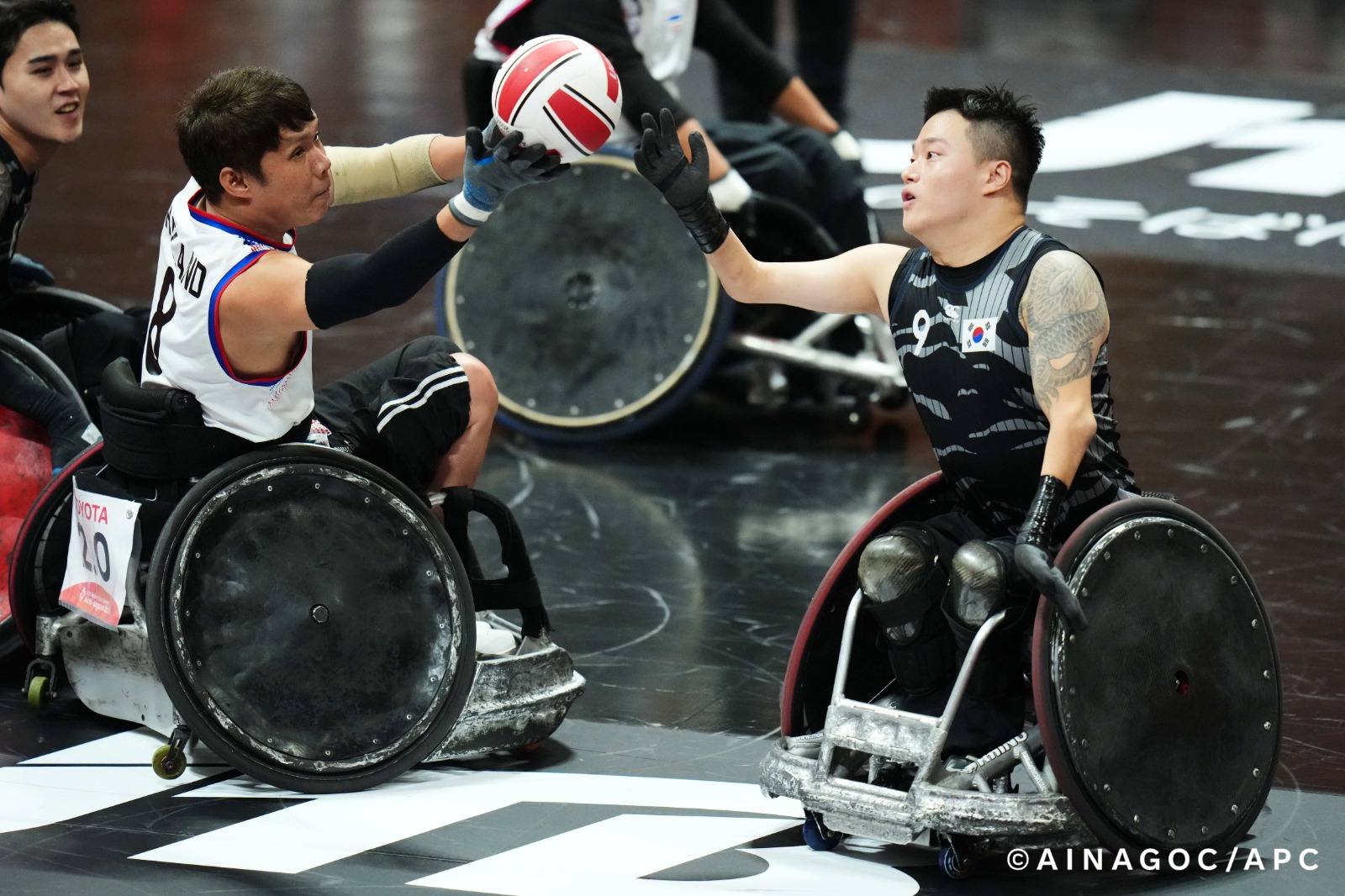
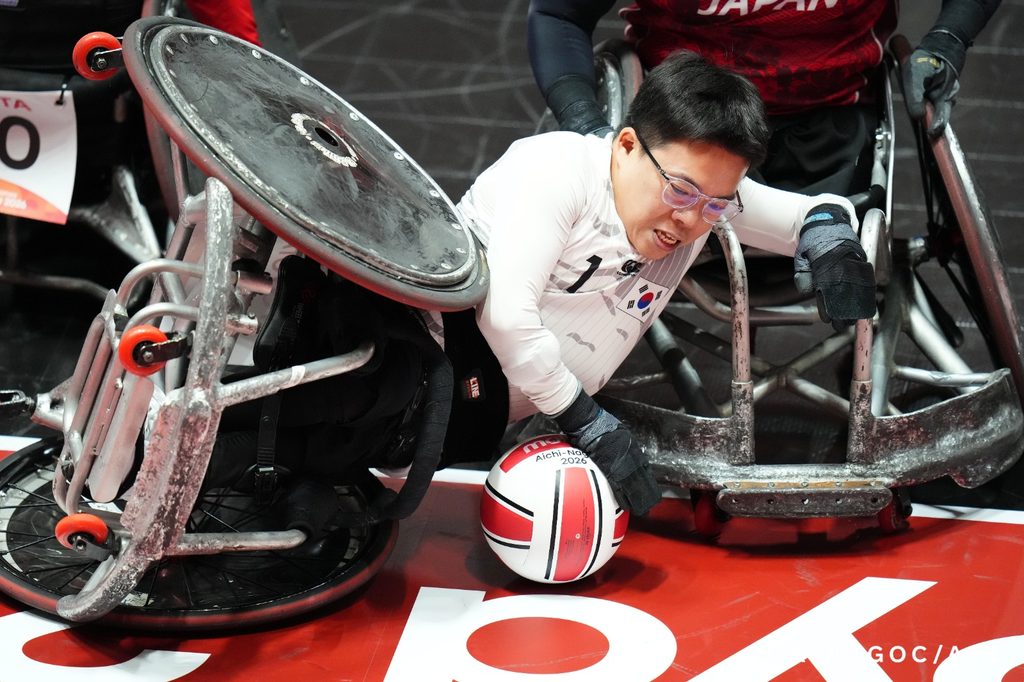
The rumbling of wheels was back. So were the collisions, the screeching tyres and the unmistakable sound of metal crashing.
Wheelchair Rugby had returned to the Asian Para Games after 12 long years, and the opening contest at Wing Arena Kariya provided a reminder of what the competition had been missing.
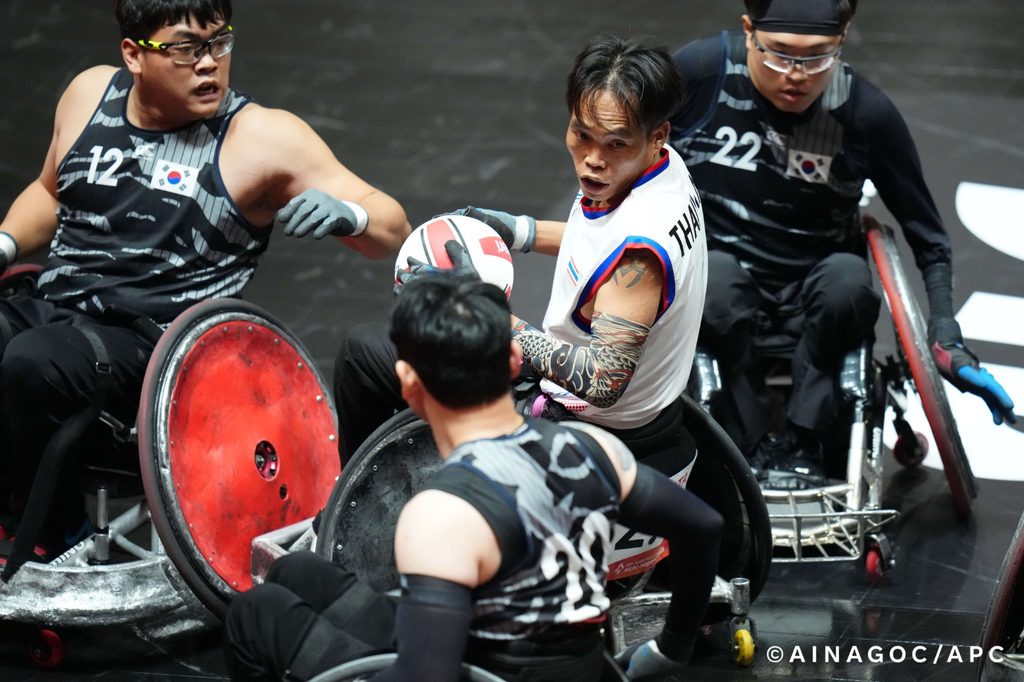
The wheelchairs took a pounding. Players fought for every inch of space, blocking, turning and accelerating through gaps that seemed barely wide enough to squeeze through. The crowd responded to every collision and attacking move. But the home supporters could not inspire Japan to victory.
South Korea produced the opening day’s biggest upset in Wheelchair Rugby, beating the reigning Paralympic champions and world No. 1 Japan 47-33 in their preliminary-round encounter.
It was a result that gave the Koreans a tremendous start and raised questions about how quickly Japan’s younger players could adapt to international competition.
A Rivalry Renewed After 12 Years
The last time Wheelchair Rugby featured at the Asian Para Games was at Incheon 2014, when Japan defeated hosts South Korea 60-40 to win the inaugural gold medal. The sport subsequently missed Jakarta 2018 and Hangzhou 2023.
Twelve years later, the same opponents were back on court, although much had changed.
Japan had gone on to win Paralympic bronze at Rio 2016 and Tokyo 2020 before claiming their first Paralympic gold at Paris 2024, defeating the United States 48-41 in the final.
That success made Japan the team everyone wanted to beat. South Korea, however, arrived in Kariya determined to show that the gap between the two Asian rivals was not as wide as recent results suggested.
The Koreans played with aggression and discipline, putting Japan’s defence under sustained pressure and making the most of their opportunities.
Japan struggled to find answers, and the 14-point defeat left coach Hideki Nakatani with plenty to consider.
Japan Looks Beyond The Defeat
For Nakatani, the result was disappointing, but the tournament is also part of a longer rebuilding exercise.
Japan have fielded a relatively inexperienced squad for their home Games, with an average age of just 25, as they prepare for the Los Angeles 2028 Paralympics and beyond.
“It’s been two months since the world championships and we wanted to try some younger players, but at the same time we’re aiming for a gold medal, so being young isn’t an excuse for losing,” Nakatani said.
Captain Katsuya Hashimoto acknowledged the responsibility that comes with being the world’s top-ranked side.
“The No. 1 world rank puts pressure on us, but we consider this an opportunity to improve this generation of players ahead of Los Angeles, Brisbane and beyond,” he said.
“These Asian Para Games are about gaining experience and putting that experience to use in future tournaments.”
Nakatani was equally clear that the defeat would not alter Japan’s ambition of reaching Friday’s final.
Korea Has Bigger Ambitions
For South Korea, the victory was more than an opportunity to upset their illustrious neighbours. Coach Yeongjun believes his players can compete with the world’s stronger teams, although he acknowledged that regular international competition remains essential.
His approach is built around communication. “We have 12 players, but even on the court or the bench, they always communicate,” he explained through an interpreter. “During the games and after that, they will be cheering up.”
The Korean captain, Lee Seonghui, meanwhile, was delighted to see Wheelchair Rugby back at the Asian Para Games.
“All I think about is winning,” he said. Having beaten Japan, he believes his team should not be intimidated by European opponents. “I think we can beat other European teams. We need more competition and practice,” he said.
He acknowledged that European teams often possess a physical advantage but felt the Koreans could match them in determination and mental strength.
Three Teams Are Not Enough
Beyond the result, the tournament has exposed a concern shared by both coaches – Wheelchair Rugby needs more countries playing the sport in Asia.
The competition was originally scheduled to feature four teams, but Malaysia’s withdrawal reduced the field to Japan, South Korea and Thailand. Each team plays the others twice before the top two contest Friday’s gold-medal match.
Nakatani believes the responsibility for developing Wheelchair Rugby must extend beyond Japan.
“We’ve gone to Southeast Asia to promote the sport and held coaching clinics, but it’s very disappointing that there are only three teams in these Asian Para Games,” he said.
“We have to keep up those efforts, but WWR (World Wheelchair Rugby) needs to work with Japan to promote Wheelchair Rugby in the region.”
The Korean coach shared that same concern. “I hope Wheelchair Rugby can develop into a sport that many countries can play together,” he said. “I hope many Asian countries can enjoy Wheelchair Rugby together.”
He pointed out that Korea holds four or five national-level competitions annually but needs greater exposure against international opposition. Importantly, winning gold in Asian Para Games does not guarantee direct qualification for Los Angeles 2028.
By ND Prashant for APC